反思
又是这样,永远最后一个小时卡在 D,之前做过一道很类似的,给出一个数 x ,每次乘个 k 乘回去,乘一次,下限是 ,上限是 ;乘两次,下限是 ,上限是 ,以此类推,乘以 m 次,下限是 ,上限是 ,最后看 m 等于多少时,给出的 y 在此范围内。当时我就想这个 D 与其很类似,我先除,一连串的除之后,再跟着一连串的乘,我每次除完,都试着往上去乘,看最后 y 是否在这个范围内。结果,T 六个,WA 两个,首先超时我能接受,时间复杂度是 ,但 wa 我是真不理解
A – Supermajority
题意
给你正整数 A 和 B 。
如果 ,则输出 ,否则,输出
思路
如果 ,则输出 ,否则,输出
代码
#include <bits/stdc++.h>
using namespace std;
#define lowbit(x) (x & (-x))
#define endl '\n'
typedef long long LL;
#define PLL pair<LL, LL>
const LL MOD = 998244353;
const LL MAX = 1e6 + 100;
const LL INF = 0x3f3f3f3f3f3f3f;

void solve() {
    int x, y;
    cin >> x>> y;
    if (x * 3 > 2 * y) {
        cout << "Yes" << endl;
    }
    else {
        cout << "No" << endl;
    }
}

signed main() {
    ios::sync_with_stdio(false);
    cin.tie(0); cout.tie(0);

    LL T = 1;
    //cin >> T;
    while (T--) {
        solve();
    }
    return 0;
}
B – Parking 2
题意
给定 , ,在此期间每小时收费 元,其余时间收费 元,不跨过午夜,问一天收费多少
思路
去枚举一天 24 小时,看当前时间段是否在 区间,有一点要注意,,什么意思呢?举个例子,如果 ,从 开始数, 时加 , 时加 , 时加 ,因为 , 时加 ,因为 , 时加 ,因为 ,这是因为我们枚举的是时间点,而每个时间点管的是当前时间点以及后面一个小时这个时间段,所以 其实代表的是 到 这个时间段,而 ,他到 点就已经结束了
代码
#include <bits/stdc++.h>
using namespace std;
#define lowbit(x) (x & (-x))
#define endl '\n'
typedef long long LL;
#define PLL pair<LL, LL>
const LL MOD = 998244353;
const LL MAX = 1e6 + 100;
const LL INF = 0x3f3f3f3f3f3f3f;

void solve() {
    LL x, y, l, r, a, b;
    cin >> x >> y >> l >> r >> a >> b;
    LL ans = 0;
    for (LL i = a; i < b; ++i) {
        if (i >= l && i < r) {
            ans += x;
        }
        else {
            ans += y;
        }
    }
    cout << ans << endl;
}

signed main() {
    ios::sync_with_stdio(false);
    cin.tie(0); cout.tie(0);

    LL T = 1;
    //cin >> T;
    while (T--) {
        solve();
    }
    return 0;
}
C – Reverse Permutation
题意
给出一个整数 n 和一个长度为 n 的由 o 和 x 组成的字符串 s,定义数组 a = 1, 2, 3 … n
若 = o,则将数组 a 的前 i 项倒置,具体来说,就是变成
若 = x,则不做任何变化
问最后数组 a 的模样
思路
呃,怎么说呢,这道题我是猜的,我发现,从 1 慢慢增大,每个数放置的位置几乎都是左一个,右一个,再左一个,右一个……我本想从小到大走,但我们无法知道 1 的具体位置,所以就选择从大往小的走,我发现,只要是 = o,这一次如果是倒着放,下一次就会正着放,反之亦然,但如果 = x,则不会改变放的方向,这就很像双端队列,只不过一个是从内部添加,一个是从外部添加
为啥这么做?别问我,我也不知道
代码
#include <bits/stdc++.h>
using namespace std;
#define lowbit(x) (x & (-x))
#define endl '\n'
typedef long long LL;
#define PLL pair<LL, LL>
const LL MOD = 998244353;
const LL MAX = 1e6 + 100;
const LL INF = 0x3f3f3f3f3f3f3f;

void solve() {
    int n;
    cin  >> n;
    string s;
    cin >> s;
    s = " " + s;

    int l = 1, r = n, op = 0;

    vector<int> ans(n + 1, 0);
    auto move = [&](int idx) {
        if (op == 1) {
            ans[l] = idx;
            ++l;
        }
        else {
            ans[r] = idx;
            --r;
        }
    };

    for (int i = n; i >= 1; --i) {
        if (s[i] == 'o') {
            op ^= 1;
        }
        move(i);
    }

    for (int i = 1; i <= n; ++i) {
        cout << ans[i] << " ";
    }
    cout << endl;
}

signed main() {
    ios::sync_with_stdio(false);
    cin.tie(0); cout.tie(0);

    LL T = 1;
    //cin >> T;
    while (T--) {
        solve();
    }
    return 0;
}
D – X to Y
题意
给出两个数 X , Y 以及一个大于二的整数 k,X 可进行以下操作使得 X 变成 Y, 最初 x = X:
- 令 ,然后
- 令 ,然后
问最少的操作次数
思路
以 k = 3 为例,发现,上述两种操作互为逆运算,意思就是说, 中 ,但也可以是 ,发现,单看乘的话,0 -> 1, 0 -> 2, 1 -> 3, 1 -> 4, 1 -> 5, 2 -> 6, 2 -> 7, 2 -> 8, 3 -> 9, 3 -> 10, 3 -> 11, 4 -> 12 , 4 -> 13 …逆运算就是把箭头反向,这样就形成了一棵树:
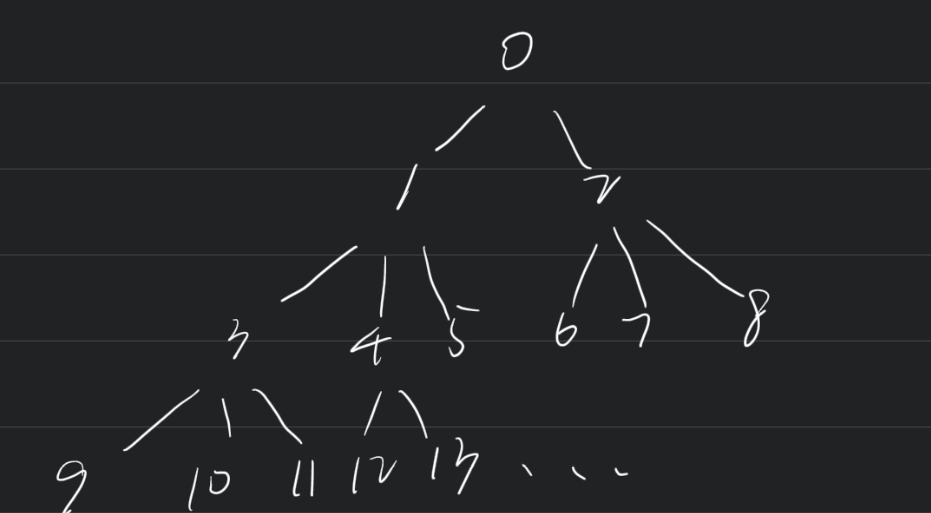
我们想让 X 变成 Y,实际上是在走一条 X 到 Y 的最短路径,即找他们的最近公共祖先,但我们不可能真的去建这么一棵双向连边的树,只是需要用到这种思想,实现方式是每次去比较 X 和 Y,让较大数除以 K,直到最后两数相等,呃,这好像就是在模拟找最近公共祖先的过程
代码
#include <bits/stdc++.h>
using namespace std;
#define lowbit(x) (x & (-x))
#define endl '\n'
typedef long long LL;
#define PLL pair<LL, LL>
const LL MOD = 998244353;
const LL MAX = 1e6 + 100;
const LL INF = 0x3f3f3f3f3f3f3f;

void solve() {
    LL x, y, k;
    cin >> x >> y >> k;
    LL cnt = 0;
    while (x != y) {
        if (x > y) {
            x /= k;
        }
        else {
            y /= k;
        }
        ++cnt;
    }
    cout << cnt << endl;
}

signed main() {
    ios::sync_with_stdio(false);
    cin.tie(0); cout.tie(0);

    LL T;
    cin >> T;
    while (T--) {
        solve();
    }
    return 0;
}
E – Digit Circus
题意
求在 998244353 的模中,有 1≤x≤N 的整数 x 满足下列三个条件中有且仅有一个条件的个数。
- x 是 3 的倍数。
- x 的十进制表示包含 3。
- x 的十进制表示恰好使用了三个不同的数字。
在这里,整数的十进制表示不应有不必要的前导 “0”。
思路
,
: 记录出现过的数字
: 记录模 3 的余数
: 记录所枚举的前 pos 位的数是否小于前 pos 位的 s
在更新 mask 的时候要考虑前导零,如果之前一个数都没出现过,也就是前面全都是 0(mask = 0),若当前枚举的 x = 0,则此 0 扔归为到前导零当中 mask 不更新,其余情况 mask 都要更新
在更新 ti 的时候要考虑之前是否已经小于 s,若已经小于,则之后都会是小于,nti = ti,若之前都是等于,而当前枚举的 x < lim(lim = s[i] – ‘0’),则 nti 更新为 1,即小于,否则,仍是等于。若之前都是等于,为防止超出 x,则枚举当前 x 的上限为 lim,否则上限为 9
代码
#include <bits/stdc++.h>
using namespace std;
#define lowbit(x) (x & (-x))
#define endl '\n'
typedef long long LL;
#define PLL pair<LL, LL>
const LL MOD = 998244353;
const LL MAX = 1e6 + 100;
const LL INF = 0x3f3f3f3f3f3f3f;

int dp[505][1 << 10][3][2];

void solve() {
    string s;
    cin >> s;
    int n = s.size();

    dp[0][0][0][0] = 1;
    for (int pos = 0; pos < n; ++pos) {
        int lim = s[pos] - '0';
        for (int mask = 0; mask < (1 << 10); ++mask) { // 枚举前 pos 位出现过的值
            for (int mod = 0; mod < 3; ++mod) {
                for (int ti = 0; ti <= 1; ++ti) { // 记录构造的前 pos 位的数是否小于前 pos 位的 s
                    if (!dp[pos][mask][mod][ti]) continue;
                    int up = ti ? 9 : lim; // 如果到目前为止仍是等于 ti = 0,为防止大于 s,则当前枚举的上限是 lim
                    for (int x = 0; x <= up; ++x) { // 枚举第 pos 位的值
                        int nmask;
                        if (mask == 0 && x == 0) {
                            nmask = 0; // 若到目前为止都是前导零,则当前的数值 x = 0 不计入出现过的数中
                        }
                        else {
                            nmask = mask | (1 << x);
                        }
                        int nmod = (mod + x) % 3;
                        int nti = ti; // 如果之前是小于,则之后一直都是小于
                        if (ti == 0 && x < lim) { // 如果之前都是等于,而第 pos 位枚举的 x < lim ,则之后都是小于
                            nti = 1;
                        }
                        dp[pos + 1][nmask][nmod][nti] += dp[pos][mask][mod][ti];
                        dp[pos + 1][nmask][nmod][nti] %= MOD;
                    }
                }
            }
        }
    }

    int ans = 0;
    for (int mask = 1; mask < (1 << 10);++mask) {
        for (int mod = 0; mod < 3; ++mod) {
            for (int ti = 0; ti <= 1; ++ti) {
                int cond = 0;
                if (mod == 0) { // 是否是三的倍数
                    ++cond;
                }
                int p = __builtin_popcount(mask);
                if (p == 3) { // 是否使用了三种不同的数字
                    ++cond;
                }
                if (mask & (1 << 3)) { // 是否出现了 3
                    ++cond;
                }
                if (cond == 1) { // 有且仅有一种条件满足
                    ans += dp[n][mask][mod][ti];
                    ans %= MOD;
                }
            }
        }
    }

    cout << ans << endl;
}

signed main() {
    ios::sync_with_stdio(false);
    cin.tie(0); cout.tie(0);

    LL T = 1;
    //cin >> T;
    while (T--) {
        solve();
    }
    return 0;
}
F – Sjeltzer?
题意
给出 个六位数字 以及他们的权值 ,保证每个数字都是不同的。给出 次询问,每次给出六位数字的 ,找出满足所有的 的权值之和
思路
设前缀和数组为 s
先看一维,给出区间 [x, y] ,ans = s[y] – s[x – 1]
扩展到二维,给出区间 ,这个的意思是,假设给出的数字都是两位,比如 ,则
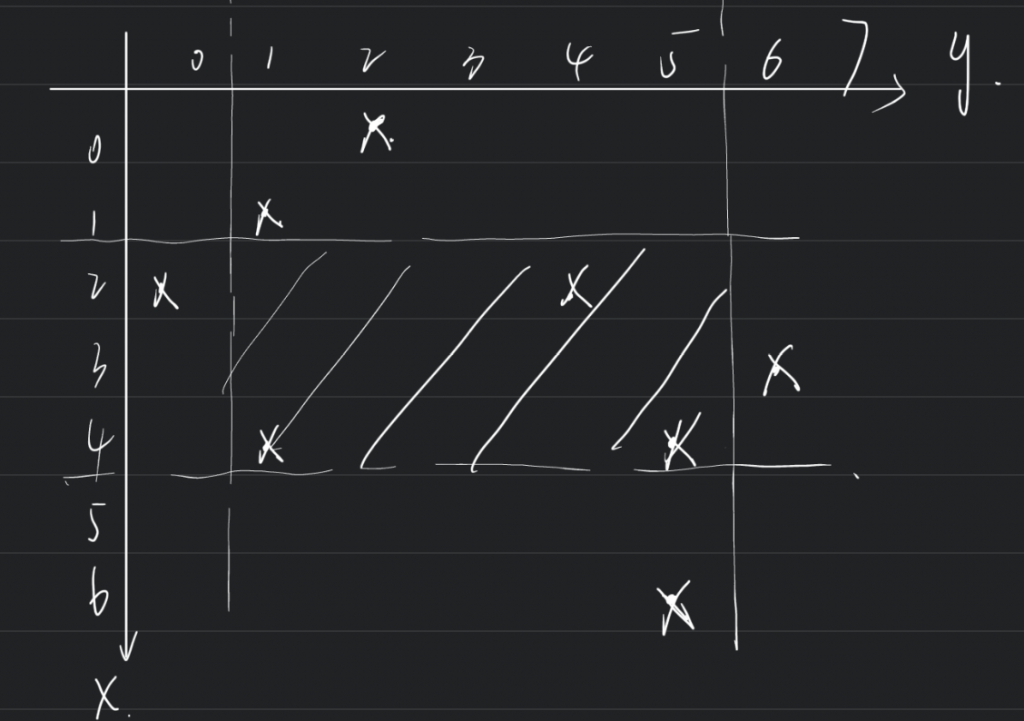
三维同理,用容斥原理,
发现,有奇数个 的形式,前面符号为减,否则,为加
对了,还有前缀和的初始化 :
一维:
for (int i = 1; i <= n; ++i) {
    string x;
    int w;
    cin >> x >> w;
    int a = x[0] - '0';
    s[a] = w;
}

for (int a = 1; a < 10; ++a) {
    s[a] += s[a - 1];
}
二维:
for (int i = 1; i <= n; ++i) {
        string x;
        int w;
        cin >> x >> w;
        int a = x[0] - '0';
        int b = x[1] - '0';
        s[a][b] = w;
    }

    for (int a = 1; a < 10; ++a) {
        for (int b = 0; b < 100; ++b) {
            s[a][b] += s[a - 1][b];
        }
    }

    for (int a = 0; a < 10; ++a) {
        for (int b = 1; b < 10; ++b) {
            s[a][b] += s[a][b - 1];
        }
    }
……以此类推至六维
代码
#include <bits/stdc++.h>
using namespace std;
#define lowbit(x) (x & (-x))
#define endl '\n'
typedef long long LL;
#define PLL pair<LL, LL>
const LL MOD = 998244353;
const LL MAX = 1e6 + 100;
const LL INF = 0x3f3f3f3f3f3f3f;

LL s[10][10][10][10][10][10];

void solve() {
    LL n;
    cin >> n;
    for (LL i = 1; i <= n; ++i) {
        LL w;
        string x;
        cin >> x >> w;
        LL a = x[0] - '0';
        LL b = x[1] - '0';
        LL c = x[2] - '0';
        LL d = x[3] - '0';
        LL e = x[4] - '0';
        LL f = x[5] - '0';
        s[a][b][c][d][e][f] = w;
    }

    for (LL a = 1; a < 10; ++a) {
        for (LL b = 0; b < 10; ++b) {
            for (LL c = 0; c < 10; ++c) {
                for (LL d = 0; d < 10; ++d) {
                    for (LL e = 0; e < 10; ++e) {
                        for (LL f = 0; f < 10; ++f) {
                            s[a][b][c][d][e][f] += s[a - 1][b][c][d][e][f];
                        }
                    }
                }
            }
        }
    }

    for (LL a = 0; a < 10; ++a)
    {
        for (LL b = 1; b < 10; ++b)
        {
            for (LL c = 0; c < 10; ++c)
            {
                for (LL d = 0; d < 10; ++d)
                {
                    for (LL e = 0; e < 10; ++e)
                    {
                        for (LL f = 0; f < 10; ++f)
                        {
                            s[a][b][c][d][e][f] += s[a][b - 1][c][d][e][f];
                        }
                    }
                }
            }
        }
    }

    for (LL a = 0; a < 10; ++a)
    {
        for (LL b = 0; b < 10; ++b)
        {
            for (LL c = 1; c < 10; ++c)
            {
                for (LL d = 0; d < 10; ++d)
                {
                    for (LL e = 0; e < 10; ++e)
                    {
                        for (LL f = 0; f < 10; ++f)
                        {
                            s[a][b][c][d][e][f] += s[a][b][c - 1][d][e][f];
                        }
                    }
                }
            }
        }
    }

    for (LL a = 0; a < 10; ++a)
    {
        for (LL b = 0; b < 10; ++b)
        {
            for (LL c = 0; c < 10; ++c)
            {
                for (LL d = 1; d < 10; ++d)
                {
                    for (LL e = 0; e < 10; ++e)
                    {
                        for (LL f = 0; f < 10; ++f)
                        {
                            s[a][b][c][d][e][f] += s[a][b][c][d - 1][e][f];
                        }
                    }
                }
            }
        }
    }

    for (LL a = 0; a < 10; ++a)
    {
        for (LL b = 0; b < 10; ++b)
        {
            for (LL c = 0; c < 10; ++c)
            {
                for (LL d = 0; d < 10; ++d)
                {
                    for (LL e = 1; e < 10; ++e)
                    {
                        for (LL f = 0; f < 10; ++f)
                        {
                            s[a][b][c][d][e][f] += s[a][b][c][d][e - 1][f];
                        }
                    }
                }
            }
        }
    }

    for (LL a = 0; a < 10; ++a)
    {
        for (LL b = 0; b < 10; ++b)
        {
            for (LL c = 0; c < 10; ++c)
            {
                for (LL d = 0; d < 10; ++d)
                {
                    for (LL e = 0; e < 10; ++e)
                    {
                        for (LL f = 1; f < 10; ++f)
                        {
                            s[a][b][c][d][e][f] += s[a][b][c][d][e][f - 1];
                        }
                    }
                }
            }
        }
    }

    auto deal = [&](string x, string y)
    {
        LL ans = 0;
        for (LL i = 0; i < 6; ++i)
        {
            LL a = x[i] - '0';
            LL b = y[i] - '0';
            if (a > b)
            {
                return 0LL;
            }
        }

        for (LL mask = 0; mask < (1 << 6); ++mask)
        {
            LL ok = true;
            vector<LL> p(7, 0);
            for (LL i = 0; i < 6; ++i)
            {
                LL a = x[i] - '0';
                LL b = y[i] - '0';
                LL d = (mask >> i & 1);
                if (d)
                {
                    if (a == 0)
                    {
                        ok = false;
                        break;
                    }
                    p[i] = a - 1;
                }
                else
                {
                    p[i] = b;
                }
            }

            if (!ok)
            {
                continue;
            }

            LL sign = (__builtin_popcount(mask) & 1) ? -1 : 1;
            ans += sign * s[p[0]][p[1]][p[2]][p[3]][p[4]][p[5]];
        }

        return ans;
    };

    LL q;
    cin >> q;
    while (q--) {
        string x, y;
        cin >> x >> y;
        LL res = deal(x, y);
        cout << res << endl;
    }
}

signed main() {
    ios::sync_with_stdio(false);
    cin.tie(0); cout.tie(0);

    LL T = 1;
    //cin >> T;
    while (T--) {
        solve();
    }
    return 0;
}
优化代码
将六维压缩成一维
#include <bits/stdc++.h>
using namespace std;
#define lowbit(x) (x & (-x))
#define endl '\n'
typedef long long LL;
#define PLL pair<LL, LL>
const LL MOD = 998244353;
const LL MAX = 1e6 + 100;
const LL INF = 0x3f3f3f3f3f3f3f;

void solve()
{
    LL n;
    cin >> n;
    vector<LL> s(1000000, 0);

    for (LL i = 1; i <= n; ++i)
    {
        LL x, w;
        cin >> x >> w;
        s[x] = w;
    }

    LL pw[] = {100000, 10000, 1000, 100, 10, 1};

    for (LL i = 0; i < 6; ++i)
    {
        for (LL mask = 0; mask < 1000000; ++mask)
        {
            LL p = mask / pw[i] % 10;
            if (p)
            {
                s[mask] += s[mask - pw[i]];
            }
        }
    }

    auto deal = [&](LL x, LL y)
    {
        LL ans = 0;
        for (LL i = 0; i < 6; ++i)
        {
            LL a = x / pw[i] % 10;
            LL b = y / pw[i] % 10;
            if (a > b)
            {
                return 0LL;
            }
        }

        for (LL mask = 0; mask < (1 << 6); ++mask)
        {
            // LL p, tmp = 0;
            // for (LL i = 0; i < 6; ++i)
            // {
            //     if (mask & (1 << i))
            //     {
            //         p = max(x / pw[i] % 10 - 1, 0); 只要有某一维是 -1,不代表这一维的答案是 0,而是整个答案都是 0
            //     }
            //     else
            //     {
            //         p = y / pw[i] % 10;
            //     }
            //     tmp += (p * pw[i]);
            // }

            bool ok = true;
            LL tmp = 0;

            for (LL i = 0; i < 6; i++)
            {
                LL d;

                if (mask >> i & 1)
                {
                    d = x / pw[i] % 10;

                    if (d == 0)
                    {
                        ok = false;
                        break;
                    }

                    d--;
                }
                else
                {
                    d = y / pw[i] % 10;
                }

                tmp += d * pw[i];
            }

            if (!ok)
                continue;

            if (__builtin_popcount(mask) & 1)
            {
                ans -= s[tmp];
            }
            else
            {
                ans += s[tmp];
            }
        }
        return ans;
    };

    LL q;
    cin >> q;
    while (q--)
    {
        LL x, y;
        cin >> x >> y;
        LL res = deal(x, y);
        cout << res << endl;
    }
}

signed main()
{
    ios::sync_with_stdio(false);
    cin.tie(0);
    cout.tie(0);

    LL T = 1;
    // cin >> T;
    while (T--)
    {
        solve();
    }
    return 0;
}